
Pioneer Court Docket Searches
The village runs no adult docket portal of its own. Pioneer adult traffic, misdemeanor, small-claims, and qualifying civil filings all move through Bryan Municipal Court's countywide path. That path is its Record Search and CaseLook. Felony traffic heads toward Common Pleas General once municipal preliminary proceedings wrap up. Juvenile traffic starts in Common Pleas Juvenile instead. A Pioneer address tells you where a matter arose. Only the court named on the citation tells you which docket system and clerk hold the record. That court is the key to the whole search.
- Read the Pioneer citation or notice and retain the court name, ticket number, and case number exactly as issued.
- For an adult Pioneer municipal matter, open Bryan Municipal Court Record Search.
- Search CaseLook with a single item: name, hearing date, case number, file date, or ticket number.
- Use case-number digits only, choose a relevant type if needed, complete CAPTCHA, and inspect the newest entry.
- Contact Bryan Municipal Court or use its public terminal if Pioneer results are delayed, restricted, or insufficient for the request.
Every Pioneer docket search turns on the same countywide split. An adult municipal case is not a Common Pleas felony record. A juvenile file sits in its own court, with stricter access rules.
Pioneer Police and Dispatch Do Not Keep Court Dockets
Pioneer Police and Williams County Central Communications dispatch handle local enforcement. But neither office keeps the Pioneer court docket. A police report, citation, or dispatch event is not the court's case record. Once an adult Pioneer matter gets filed as a municipal case, Bryan Municipal Court maintains the docket itself. That split between enforcement information and court-record custody tells a requester where a Pioneer case action actually lives. It marks the line clearly.
When you need a current setting, the citation and the court record beat any informal account. They beat any account of what happened. The court that entered an order, set a hearing, or received a filing is the one that can confirm it. That court speaks with authority.
Pioneer counted 1,429 residents in the 2020 Census. The village has no court of its own and no court records office. That absence is itself useful. It sends every adult municipal case to Bryan Municipal Court. It also stops a searcher from treating a village contact or a dispatch channel as the source of a hearing, judgment, or docket entry.
Inside the Pioneer Municipal Court
No separate Pioneer Municipal Court exists. Bryan Municipal Court serves the whole county for adult Pioneer traffic, misdemeanor, small-claims, and qualifying civil matters. Its Clerk, CaseLook system, payment channel, and public terminal are the municipal access points for any Pioneer case. The court also handles initial felony proceedings there. A continuing felony record, though, belongs to Common Pleas General rather than the municipal court.
Pioneer juvenile traffic lands in Common Pleas Juvenile. That division runs its own counter and may impose confidentiality limits. So the route depends entirely on what the case is: adult municipal, felony, or juvenile.
Pioneer Village Office Is Not the Record Custodian
The Pioneer Village Office sits at 409 South State Street, Pioneer, Ohio 43554. It is open weekdays from 8:00 a.m. to 4:00 p.m. It handles village administration. But it is not a court, a docket custodian, a citation-payment channel, or a court records desk. An adult Pioneer court record lives in the Bryan Municipal Court process. Once a file leaves municipal jurisdiction, a county court division maintains it.
Pioneer's official village site lays out the Village Office's role in village government.
Here the local distinction comes into focus. A Pioneer government contact is not the court clerk holding the docket, so the clerk's office remains the place to ask.
Finding Pioneer Court Dates
Check Pioneer adult municipal court dates through the Bryan case record. Use the citation too, and confirmation from the court. CaseLook allows a Hearing Date search. But Bryan cautions that data can take at least 24 hours to post after a filing or judicial action. A docket entry may also show an earlier setting. A later continuance or order may have changed it. Read the latest entry alongside the citation. Never swap it for a general county or village calendar.
| Date | Use the newest Bryan docket entry or Pioneer citation and confirm an imminent setting with the court. |
|---|---|
| Time | Read the notice or contact Bryan Municipal Court if the online result does not display a current time. |
| Location | Pioneer adult municipal matters are held through Bryan Municipal Court, not the Pioneer Village Office. |
| Judge | Use the docket or court contact for any presiding-official information that is not shown publicly. |
| Setting type | Look for arraignment, pretrial, motion hearing, trial, compliance, or another stated court event. |
Pioneer Has No Local Court or Camera Portal
Pioneer runs no local court of its own. Look for a village traffic portal or camera-enforcement system and you will come up empty. The village does not offer one. That matters for anyone searching the web for a Pioneer citation. The route for adult cases runs through the shared Bryan municipal system. The Common Pleas divisions at the county level handle the remaining case types.
A ticket or notice must be read for the court it names. Village offices can offer context, but the court record itself sits with whichever court holds the file. A request has to go there. So the court name and case number on the paperwork matter more, not less.
If the ticket names Bryan Municipal Court, its CaseLook, payment, terminal, and clerk channels all apply. Each one is available for that case. Felony and juvenile matters belong with the county division instead. Skip the guesswork of a local search. Go straight to the official court channel the notice identifies.
Pioneer Traffic Ticket Lookups
For a Pioneer adult traffic ticket, the lookup tools belong to Bryan Municipal Court. That means CaseLook plus the eligible-payment channels. CaseLook accepts searches by Name or Company, Hearing Date, Case Number, File Date, or Ticket Number. Enter numbers only in the Case Number field, 12 characters at most, while Ticket Number runs up to 32 characters. Traffic, Criminal, Civil, Small Claims, and Parking are the case type options. Search one field at a time. Complete the CAPTCHA before you expect a result.
A ticket that requires appearance stays a court matter. The payment search works only for eligible charges. It is not the authority on a current court date. Nor does it cover a court record, or a court action that has not yet posted.
Pioneer CaseLook and Calendar Fields
Pioneer cases live in Bryan's shared CaseLook interface, not a village database. The fields narrow a municipal query. Use name, date, case number, file date, or ticket number. On the county side, the CivicEngage calendar offers event selectors for Common Pleas, Juvenile, and Probate, but it does not serve as a full individual Pioneer municipal case calendar. For a municipal setting, the court-specific entry is the better source. One caveat stands. Bryan's Record Search page warns that online information may lag at least 24 hours after action.
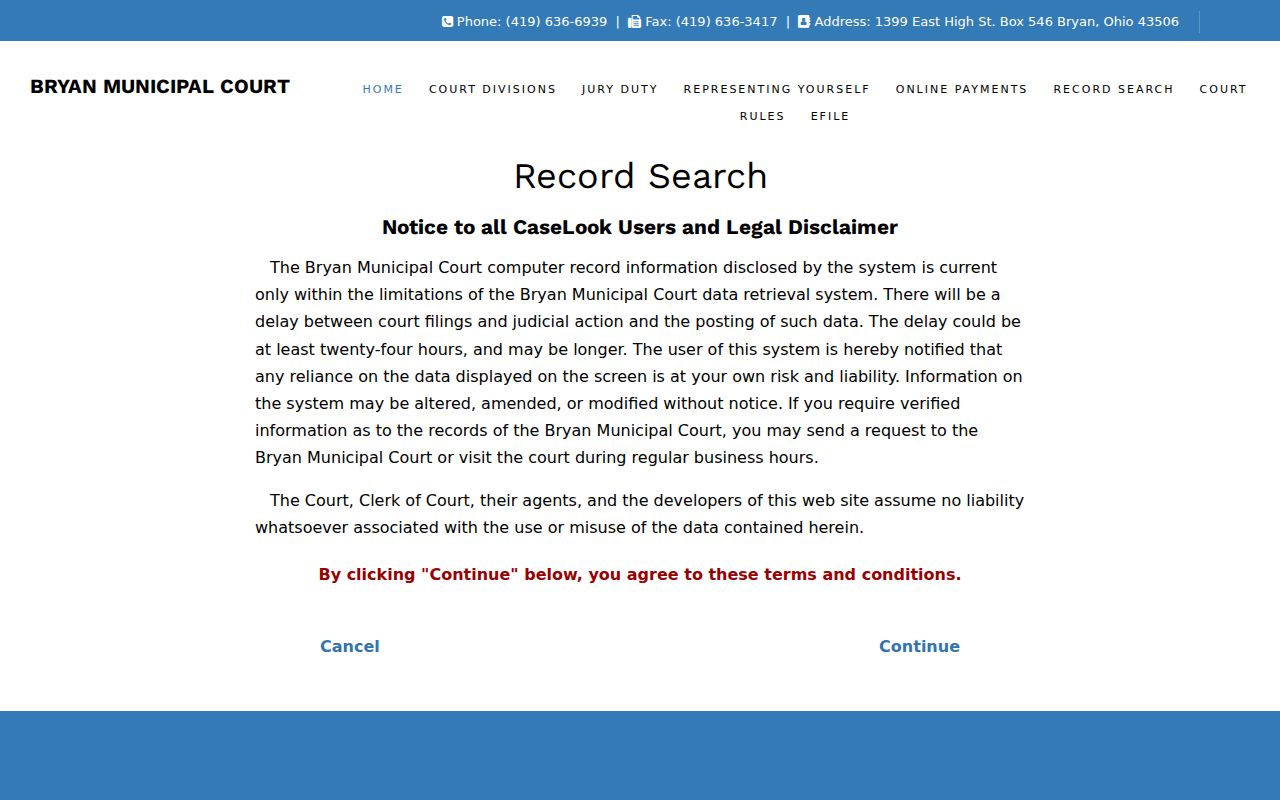
That shared disclaimer is the reason to confirm a current Pioneer setting with the court. Do this whenever the displayed result seems stale. CaseLook also lets you set the number of results. The published default is 25, with 50, 100, or 250 available. The option helps when a Pioneer name search returns several municipal results at once, though the court recommends searching one item at a time. Keep the setting in perspective. It controls the display only and says nothing about the scope or completeness of Pioneer court records. A precise case number or ticket number is still the stronger starting point whenever you have one.
How Pioneer Cases Reach the County
Pioneer adult municipal cases stay on the Bryan Municipal Court route. The case type can demand another court. A felony traffic case moves to Common Pleas General. That happens after municipal preliminary handling. Juvenile traffic starts in Common Pleas Juvenile, never in the adult municipal docket. Probate, Domestic Relations, and broader civil matters each have their own county division.
A Pioneer case may move past its first court. When it does, the case number, court name, and latest entry are the reliable guide.
Docket flow: Pioneer citation or complaint → Bryan Municipal Court for adult municipal matters → Common Pleas General or Juvenile when required → Ohio Sixth District Court of Appeals for an appeal.
Follow that flow. An early municipal entry can then never be mistaken for the final Pioneer felony or juvenile record.
Pioneer Waiver Payments and Required Appearances
An eligible Pioneer municipal traffic citation can be paid through Bryan's online payment search. A Last Name is required. First Name is optional. The instructions warn that one ticket may carry separate suffix-letter charges. A waiver requires payment of every listed charge. Paying a waiver on an eligible minor misdemeanor counts as a guilty plea. When appearance is required, no payment assumption can take its place; check the court notice and current case record to confirm.
Bryan's payment search is the official shared route for an eligible Pioneer ticket.
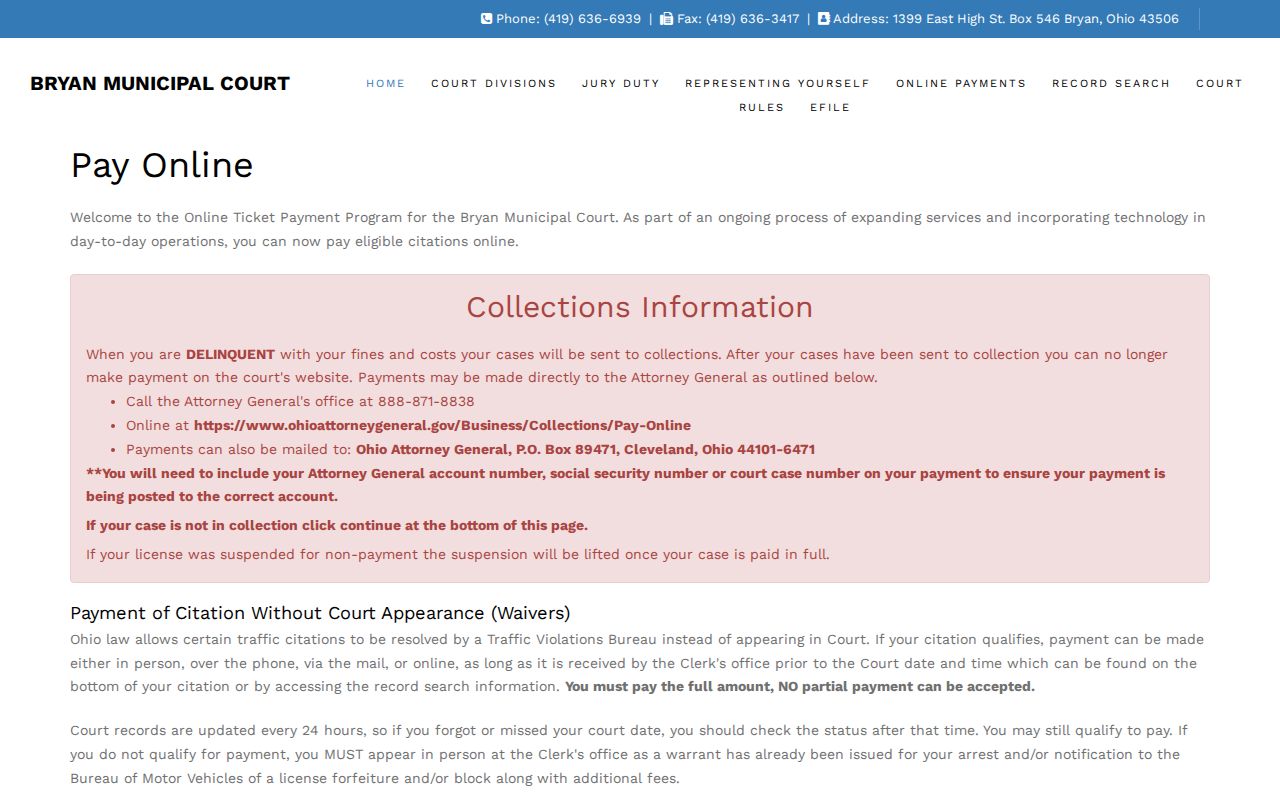
The payment page covers eligible charges and nothing more. For a case setting and the full case record, the court docket and clerk remain the sources a Pioneer case demands.
Who Can See Pioneer Court Records
Pioneer court records sit within the Ohio court access framework. They are limited by whichever court holds the record and by restrictions on particular material. A search that returns nothing can mean several things. The wrong court may have been searched, or CaseLook may simply be delayed. The record could be sealed or redacted. The matter could be confidential juvenile material, or a protection-order restriction could be in play. The public-access terminal at Bryan Municipal Court offers an inspection alternative for a municipal file, yet it cannot replace the county division that owns a different case.
Key Rules:
Ohio Revised Code 149.43 establishes public-record access and copying requirements, subject to legal exceptions.
Rules of Superintendence 44–47 govern court-record access, remote availability, and personal identifiers.
Ohio Revised Code 2151.356 supplies juvenile-record sealing pathways that can restrict public access.
Pioneer Court Record Handoffs
A Pioneer case rarely stays in one building. Bryan Municipal Court keeps the adult municipal cases. When a matter grows into a felony, Common Pleas General takes over the record. Juvenile traffic belongs to Juvenile Court. Appeals land with the Sixth District. Pioneer itself has no standalone clerk who tracks files across those systems, so the court currently holding the record decides where your request goes. A Pioneer address, or whichever office first took a report, will not steer you right.
When you write to a court, name the court, the case number, and the document or hearing you want. That detail matters most once a case has moved past the municipal stage.
There is also a fallback for remote searches. Bryan Municipal Court's local rules allow public access to records through a terminal at the courthouse. The rules do not spell out where the terminal sits, which documents carry images, or when the records desk closes each day. A phone call before a trip to Pioneer's shared municipal route saves trouble. The terminal works well for inspecting a municipal file. It does not hand a Pioneer Common Pleas, Probate, Juvenile, or appellate case over to the municipal clerk.
Copy requests follow custody too. Whichever court maintains the Pioneer-related case can tell you whether a plain copy, an inspection, a certified copy, or some other procedure fits your need. Keep the citation or case number, the court name, and a short description of the record together. That makes the request precise. It also spares a village office from hunting for a docket it never kept.