
Williams County Civil Docket Searches
Start any Williams County civil docket lookup with the county's Domestic and General Courts Records Search, which covers Common Pleas General Division and Domestic Relations cases. The county frames the online tool as a convenience. Behind it sits the real record keeper. The Williams County Clerk of Courts Legal Division maintains the Common Pleas files, so once you pull a party name or case number online, the clerk can verify the entry and provide copies. For official work, the clerk's office is the authority.
The Common Pleas record-search entry page shows the official starting point for the county's General and Domestic civil docket route.
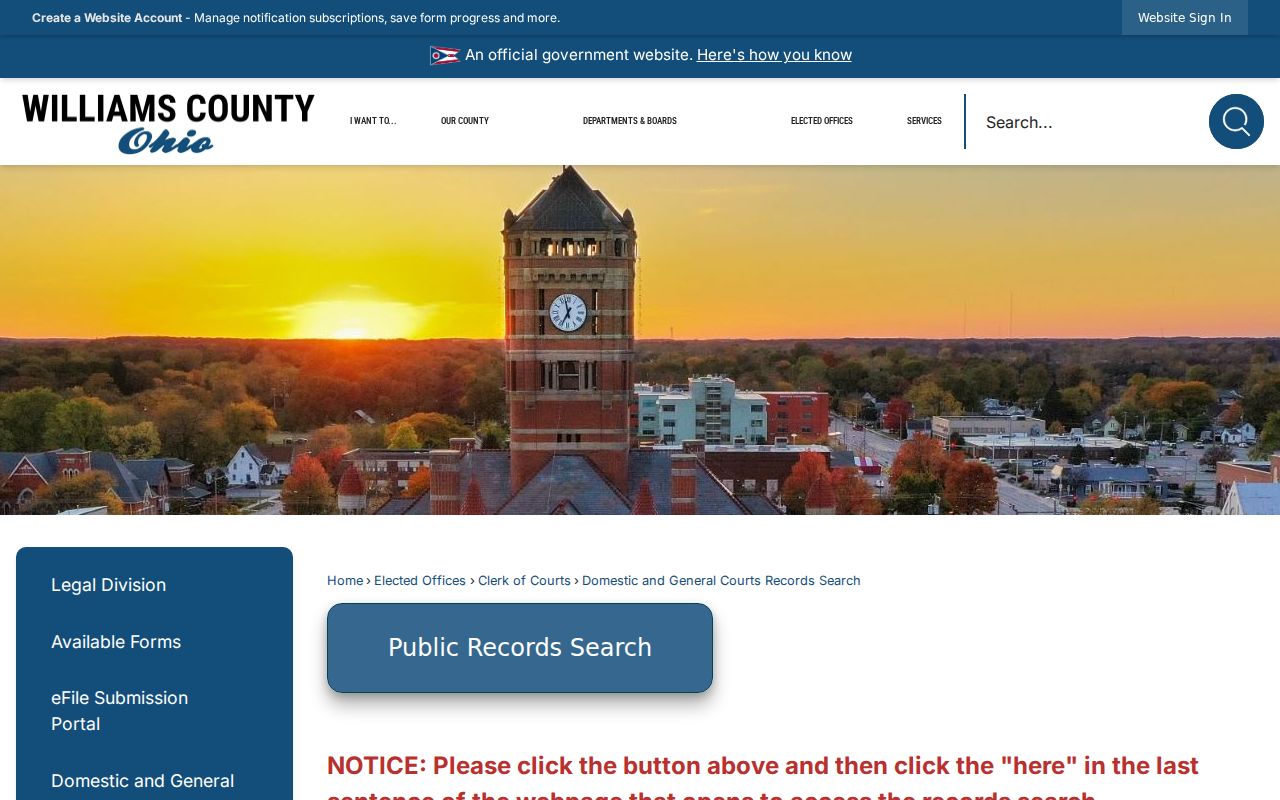
That entry page routes you. The Legal Division still holds the records behind any Common Pleas docket entry. Bryan Municipal Court runs its own civil and small-claims docket. Its civil jurisdiction covers cases up to $15,000, small claims included. Identify the case family and party names first. Then confirm which court actually owns the file. If the online result leaves questions, the municipal court's public terminal and counter are open alternatives.
- Identify whether the case is Common Pleas General, Domestic Relations, or Bryan Municipal Court civil or small claims.
- Search by a party name or the court's case number through the matching court channel.
- Open the case that matches the parties and case family.
- Read the filing entries, service status, setting, and judgment information in date order.
- Use the clerk or court counter for certified copies, audio, or a complete record when needed.
Williams County Civil Docket Channels
Common Pleas records run through the county search and the Legal Division. But Bryan Municipal Court keeps its own civil records. Its site offers CaseLook access for case lookups. The Bryan Municipal Court Civil Division page explains the court's civil role. It also covers how the court handles records. For Civil and Small Claims questions, call 419-636-6939, extension 3. When an online search comes up empty, the counter or public terminal at the courthouse often gives a stronger check.
Domestic Relations matters, including divorce and dissolution, go through Common Pleas Domestic Relations rather than the municipal court. Probate and Juvenile records sit outside the general online search too. So a failed general search is not proof that a court file does not exist. Knowing which division holds the case matters before you give up on a docket search.
The Bryan Municipal Court Civil Division page identifies the local civil forum. It also lists its record services.
Seen in that light, a municipal civil docket is one piece of the wider Williams County court-record system.
Civil Dockets: What They Show
Think of a civil docket as the case's timeline. It names the court and case family. It lists the parties as recorded. It also tracks each filing. Expect a complaint, summons or service activity, a responsive pleading, a motion, a pretrial, trial, judgment, or postjudgment items. An entry alone proves nothing about the truth of what a filing claims. A docket search helps you locate the record; the docket shows the sequence of court action. Check the service entry before assuming a response deadline. Then read the judgment and postjudgment entries before assuming the case is over. Certified documents are separate from an online entry label when you need an exact order or a complete record.
| Court and case family | Shows whether the file is General, Domestic Relations, Bryan civil, or small claims. |
|---|---|
| Claim and parties | Identifies the court-recorded claim and parties; the docket is not a live field report. |
| Service | Records summons and service activity that affects the next procedural step. |
| Settings | May list a pretrial, motion hearing, trial, or later court date. |
| Judgment and financial entries | Can show judgment, satisfaction, and later collection-related filings. |
| Documents and certification | Helps locate filings that may be requested as plain or certified copies. |
Williams County Civil Docket Case Types
Case type determines where the civil docket lives. Common Pleas General Division takes matters needing general jurisdiction. Domestic Relations handles the county's divorce and dissolution work. The county's General and Domestic Relations court page draws that line clearly. Bryan Municipal Court offers a separate civil forum for claims within its jurisdiction and for small claims.
| Court route | Examples in the docket | Record focus |
|---|---|---|
| Common Pleas General | Personal injury, contract, tort, foreclosure, and malpractice matters | Filings, motions, settings, judgment, and documents |
| Domestic Relations | Divorce, dissolution, and related domestic cases | Case entries subject to applicable access limits |
| Bryan civil and small claims | Civil cases within the $15,000 limit and small claims | Service, pretrial, trial, judgment, and postjudgment entries |
The General and Domestic Relations page shows the division context for these civil docket categories.
Check the division page first. It points you to the right Williams County civil docket route before you hunt for a case.
What Cases Fill the Civil Docket
A civil docket can carry a dispute from filing through enforcement. General Division examples include personal injury, contract, tort, foreclosure, and malpractice. Divorce and dissolution fill Domestic Relations dockets. In Bryan Municipal Court, a civil or small-claims case runs its own filing and hearing track. Always let the court, not a broad label, decide which docket source and records counter to contact. The Bryan civil sequence runs complaint, summons and service, responsive pleading, pretrial or motion hearing, trial, judgment, then postjudgment activity. That order explains a lot. An early docket may show a complaint and summons but no hearing date. A judged case may still gain entries later. A judgment is major, but it is not always the last word on the docket.
Williams County Civil Docket Judgment Terms
Postjudgment terms read easier with a glossary. A certificate of judgment relates to a judgment record. A debtor examination is a court process that can follow judgment. Garnishment entries, wage and nonwage, deal with collection. A satisfaction or dismissal shifts the case posture. A motion to revive, transfer, or vacate signals a different postjudgment step entirely.
- Certificate of judgment
- A record connected to a court judgment.
- Debtor examination
- A postjudgment proceeding concerning the judgment debtor.
- Garnishment
- A wage or nonwage collection process appearing on the court docket.
- Writ of restitution, execution, or replevin
- A court writ that may be requested after the underlying case reaches that stage.
Labels only go so far. Match each judgment term to the dated entries around it. The filing, the court order, or the clerk record supplies the authoritative detail, not the label itself.
Hearings on the Civil Docket
A civil case in Bryan Municipal Court usually moves in stages. Service comes first, then responsive pleadings, and then a pretrial, motion hearing, or trial. Local practice sets most civil pretrials within 30 days after the responsive pleadings are filed. That is the pattern, not a promise. Every docket date has a purpose. So read the entry and see whether it is a pretrial, a motion hearing, a trial, or a postjudgment step before assuming anything from the date itself.
Continuances work differently. The local rules require a written motion plus a proposed judgment entry. The case record will show the setting that results. Someone tracking a Williams County civil docket can use the Williams County Docket Search route to find the right case before checking individual hearing entries.
Williams County Civil Docket Timing
On a Williams County civil docket, the order of entries tells the story. A summons and service entry comes before the responsive-pleading stage. Bryan Municipal Court then ordinarily schedules a civil pretrial within 30 days after those pleadings. Though a motion, a court order, or a continuance can push the schedule in another direction. When a setting shifts, trust the updated docket entry over any earlier assumption about timing.
Dormant cases get their own rules. After notice, a regular civil case in Bryan Municipal Court can be dismissed for want of prosecution after six months with no activity. A small-claims case can be dismissed after four months. A dismissal-for-want-of-prosecution entry means the court acted on the docket. It says nothing about the merits of the dispute. The current case entry and any later filing hold the real status.
Note: Confirm a continued civil setting from the latest court entry. A filing that asks for a new date is not itself the new date.
Who Can See Civil Dockets
Civil docket entries in Williams County are public court records. But public does not mean unlimited or fully online. Ohio's rules on court-record access control what is open. Sealed records, confidential material, and parts of domestic or protected filings may carry limits. Probate and Juvenile matters also sit outside the county's general Common Pleas record-search channel. So a broad search never replaces each division's rules.
The practical path is simple. Search online first. Then call the right clerk or court counter with any access question. The Ohio Rules of Superintendence set the framework that courts follow. If a restriction appears online, respect it rather than hunting for a side door.
Access reminder:
Common Pleas General and Domestic records follow the county search and Legal Division route, subject to the court's access rules.
Bryan civil and small-claims records can be checked through the municipal court's record channels, counter, and public terminal.
Sealed or otherwise restricted records are not made public merely because related docket information can be found.
Williams County Civil Docket Copies
A docket lookup tells you what the case is. The clerk produces what you can hold. At Bryan Municipal Court, certified copies run $2 per page, and an audio CD costs $10. Common Pleas material costs more to formalize. Certification runs $2 per document on top of the copy charge. A complete record is $2 per page. Those figures mark the line between a free search and a certified filing or full record.
Find out which court owns the file before asking. Municipal cases go through the Civil and Small Claims counter and public terminal at Bryan Municipal Court. Common Pleas records live with the Legal Division. Give the clerk the case number, the document, and the copy type you need. The right fee and access rule follow. Bryan Municipal Court's fee page posts the current municipal charges for record requests.
The fee schedule treats these as distinct items. Request a docket entry, a certified copy, and an audio record separately.