
Williams County Court Record Requests
Go straight to the office that holds the file. The Williams County Clerk of Courts Legal Division keeps Court of Common Pleas records. General and Domestic Relations files both sit there. Probate and Juvenile each run their own deputy-clerk counters. Bryan Municipal Court keeps its own municipal files, too. The Common Pleas online search and Bryan CaseLook can help you identify a case. Each is a convenience route, though, rather than a certified record.
Ask by name for what you want. That could be a docket printout, a document, a certified copy, an audio copy, or a transcript. Include the court or division, the case number, a document title if you know it, and a date range. The county publishes no standard certified-copy request form. It sets no fixed turnaround, ID checklist, or complete payment instructions. Call before mailing payment or documents. Bryan's record-search notice directs anyone seeking verified information to submit a written request or visit during regular business hours.
- Identify the court and record type before making the request.
- Use the online case-information route to locate a Common Pleas or Bryan case when available.
- Inspect at the appropriate counter or Bryan public terminal when online information is incomplete or restricted.
- Call the custodian to confirm availability, fee, and a permitted mail or written-request method before sending anything.
- Make a specific Ohio public-records request to the office maintaining the record when that framework applies.
The channel depends on the file. Common Pleas General and Domestic Relations requesters can start with the county search. Then inspect the record behind the entry, or ask the Legal Division for it. At Bryan, CaseLook locates a municipal matter. The court's published verification options, though, are a written request and an in-person visit. Probate and Juvenile requests go to their own counters. Ohio offers no unified statewide trial-court records portal. The Supreme Court of Ohio runs a separate docket system. It does not replace these local offices.
County public-records policy permits copies at cost. It allows advance payment and mailing when required, and calls for preparation within a reasonable period. It supplies no universal Court of Common Pleas mail form. Nor is there one email process for every document. A short call prevents a request sent the wrong way. It also prevents one sent to the wrong division, or missing the document title a record actually needs.
Williams County Court Records: Docket or Document
Three different records get confused all the time. A docket or case-information screen is just a chronological index of court actions. Filed documents are the complaints, motions, orders, judgments, exhibits, or transcripts behind those entries. A certified copy is an authenticated copy a clerk or court issues for official use. The county describes Common Pleas web results as computerized public information and does not present a search result as a certified record.
Bryan Municipal Court's local rules draw the same line. The docket and original filed papers stand as the final record. The Record Search notice offers online information with a written-request or in-person fallback for verification. Naming the item keeps a docket request from being mistaken for a request for the actual order or hearing recording.
| Record | What it is | Best local route |
|---|---|---|
| Docket / case information | Chronological public-facing index of filings and actions. | Correct court’s online search, then counter confirmation. |
| Filed document | The actual complaint, motion, order, judgment, or exhibit. | Request from the court custodian. |
| Certified copy | Copy authenticated by the clerk or court. | Ask the appropriate clerk about certification and copy charges. |
Kinds of Court Records
What you can get depends on the court and the case. The Legal Division handles legal documents in the Common Pleas matters it covers. It certifies, indexes, maintains, and records them. Bryan keeps separate civil and criminal dockets along with filed papers. Limits also vary by court, especially for sensitive Probate and Juvenile matters.
- Docket or case-information printouts that identify entries and settings.
- Filed pleadings, such as a complaint, motion, answer, indictment, or petition.
- Signed orders, journal entries, judgments, and dispositions.
- Certified copies requested from the court custodian.
- Hearing audio or transcripts requested through the recording or reporter process.
Williams County Legal Division Court Records
The Legal Division serves as the record keeper for Common Pleas General and Domestic Relations matters. Locally filed Sixth District appeals go through it as well. It states that public records are open for inspection during regular business hours. Its duties include certifying, indexing, maintaining, and recording papers. That makes it the direct channel when you need a Common Pleas document rather than a search result alone. It matters most for certifications and papers you cannot view online.
Williams County's Clerk of Courts landing page identifies the county office. It also points to the Legal Division record-services route for these files.
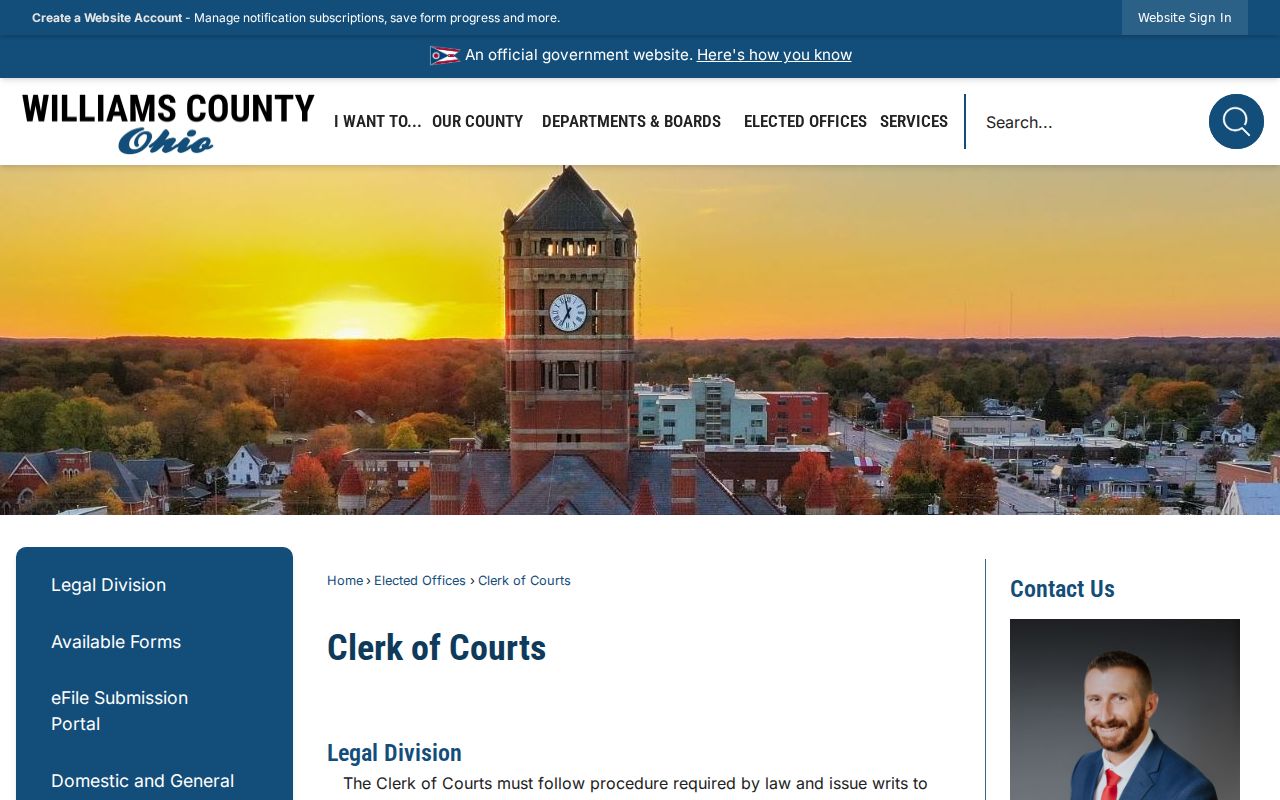
The Clerk landing page helps you connect an online case entry to the office that holds the underlying Common Pleas file. The county's Legal Division page lays out that record-keeper role and the inspection route for Williams County court records.
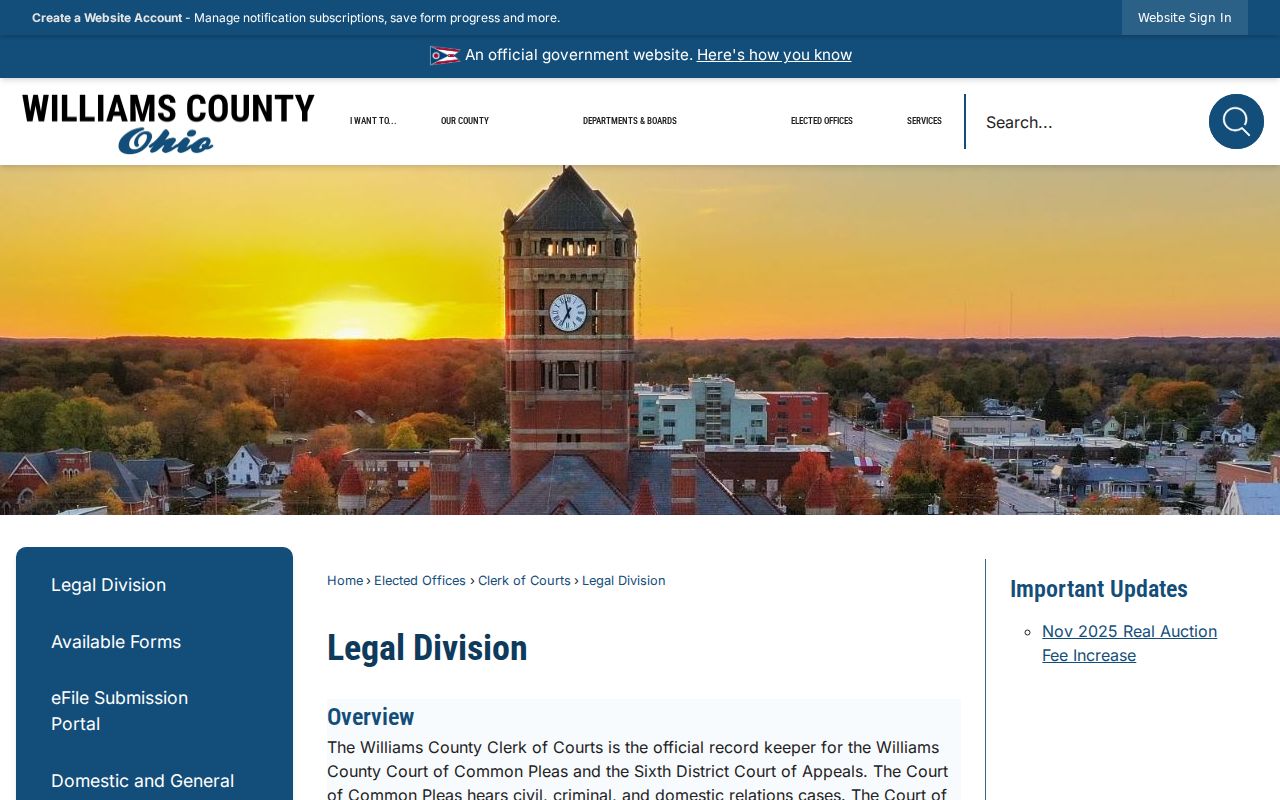
Going direct matters most for filed papers and certifications. It also helps when an online category simply cannot be viewed remotely.
Williams County Clerk of Courts, Legal Division
1 Courthouse Square, 3rd Floor
Bryan, OH 43506
419-636-1551
Court Records: What They Contain
A court file runs deeper than a single line on the docket. The docket lists events in order. The file can hold the actual papers that set those events in motion. Some documents and fields simply are not available online. Williams County publishes no official sample docket to lean on. The parts described here commonly appear in a court record. No one screen promises to show them all.
| Case number | The court-assigned identifier that connects a request to the correct file. |
|---|---|
| Caption and parties | The case heading and the roles of the parties. |
| Docket | The dated sequence of filings, settings, orders, and other case actions. |
| Pleadings and motions | Papers asking the court to begin, answer, or decide an issue in a case. |
| Orders, judgment, disposition | Written court action, decision, or recorded outcome. The latest signed entry controls over an older event notice. |
Williams County Court Records: Audio or Transcript
Hearing audio works differently from paper copies. The electronic recording is the official record of a hearing. That rule comes from the Common Pleas local rules. Want a transcript or an audio copy? Use Forms A-I and A-II, and expect to pay the professional reporter's customary fee or a deposit for a transcript. That path is separate from asking the Legal Division for a copied pleading or a certified judgment. Bryan Municipal Court records proceedings by approved means too. Copies are available on request once payment is made. Its Civil Division page lists an audio transcript on compact disc at $10. Check the specific court's process first, because no single countywide procedure applies.
Copy Fees and Certification
Fee figures belong to the court that published them. The Common Pleas cost schedule sets certification at $2 per document plus the copy charge. A complete record runs $2 per page. Fax service costs $2 plus $1 per page per transmission. The court's current cost page also lists plain paper copies at $0.10 per page. Treat these as local schedule figures. They are not a promise that every item exists or that Bryan charges the same rate.
| Custodian / item | Published amount | Request note |
|---|---|---|
| Common Pleas certification | $2 per document plus copy charge | Confirm document availability with Legal Division. |
| Common Pleas complete record | $2 per page | Published cost-schedule amount. |
| Common Pleas plain paper copy | $0.10 per page | Confirm special-format or certification needs. |
| Common Pleas fax | $2 plus $1 per page per transmission | Confirm transmission and request method first. |
| Bryan Civil certified copy | $2 per page | Municipal Civil Division’s published rate. |
Certified civil copies get their own rate at Bryan Municipal Court. The fee page breaks out what that court charges for a certified copy of a civil record and how it differs from other requests.
The municipal schedule is not the Common Pleas schedule. Before trusting any listed rate, confirm which court actually holds the record you need.
Williams County Court Records Policy Links
The Clerk’s Available Forms page gathers the local rules, the public-records policy, the fee schedule, and the forms for each division in one spot. For anyone building a Williams County court-records request, that page is the natural first stop for the official materials that govern the process. One caution is worth adding. The Common Pleas eFile form is built for filing new cases, not for requesting certified copies or general records, and its queue and filing disclosures are not a route to public records. Treat it accordingly.
The Clerk’s forms and policy page is the source for this Williams County court-records reference, and the official page it leads to shows the full set of governing materials.
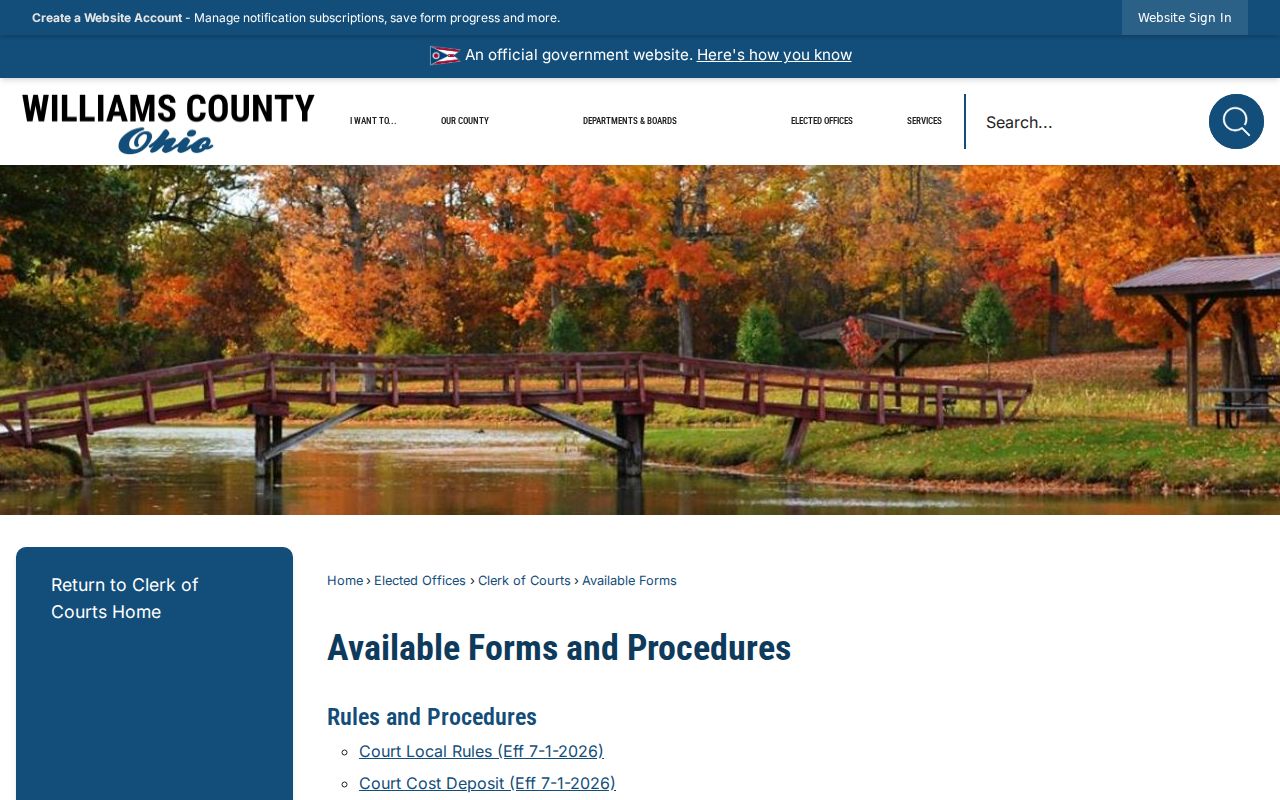
A fee schedule is not a request method. A local rule states the terms, but the record keeper still confirms how your request actually proceeds.
Access Rules for Court Records
Ohio access law and court rules frame your rights. Statutes and court orders can still restrict access. Under the county policy, copies may be charged at cost, and advance payment or mailing may be required. Records should be prepared within a reasonable time. When something is redacted or denied, the policy calls for an explanation. For the legal route, go to the office that maintains the particular file.
Key access authorities.
Ohio Sup.R. 44–47 define court records and establish public-access and remote/direct-access rules.
Ohio Revised Code 149.43 is the general public-records access and copying framework, subject to exemptions and court confidentiality rules.
Ohio Revised Code 2953.32 addresses sealing or expungement of conviction and bail-forfeiture records.
Ohio Revised Code 2151.356 provides juvenile-record sealing pathways.
Williams County Court Records and Redactions
Restricted access does not mean a record never existed. Common Pleas remote access leaves out civil-protection-order and stalking civil-protection-order records, and the Clerk counter is the county's stated route for those files. Juvenile matters can be confidential. So can sealed or expunged records, adoption material, and personal identifiers, which may be redacted or limited to direct access. Ask the custodian directly. Find out whether part of a file can be inspected or copied, whether a redaction applies, and whether a court order or another procedure is required. A gap online proves nothing about a case's status. For Bryan records, use the Clerk's written-request, in-person, or public-terminal route. Contact Probate and Juvenile at the division counter. Be specific in the request. Include the court, case number, record title, and date range so the custodian can find the file and explain any lawful limit.